I spent three weeks reading contractor forum threads, job site reviews, and talking to trim carpenters, cabinet installers, and remodelers about their portable workbench setups. The gap between what manufacturers advertise and what actually survives daily professional use is staggering.
The Setup Most Contractors Start With (And Why It Fails)
Week 1: Buy a $70 folding bench from Home Depot or Lowe's. Weighs 30 pounds, claims 1,000-pound capacity, sets up in 10 seconds. Looks perfect.
Week 3: The plastic top flexes when cutting. Clamps strip out. Legs wobble on anything except perfectly flat concrete.
Month 2: Back to sawhorses and plywood.
One trim carpenter on a contractor forum: "I have an old Craftsman folding portable workbench...the 5/8" top just ain't cutting it and the clamping feature has long since broken." Another adds: "After lots of use on them, the plastic seems to be getting brittle and if I pull on them with weight I feel cracking."
This pattern repeats constantly. Contractors buy budget folding benches, use them for real work, and they fail. Not catastrophically—they just become useless for anything requiring actual precision or stability.
What Separates Job Site Benches from Garage Hobby Benches
The difference isn't obvious until you use both daily. Here's what actually matters when you're billing $100+ per hour:
Setup time compounds. 15 minutes daily setup = 65 hours annually = $6,500 in lost billable time for a $100/hour contractor. The Dash-Board's 60-second setup isn't a convenience feature. It's income protection.
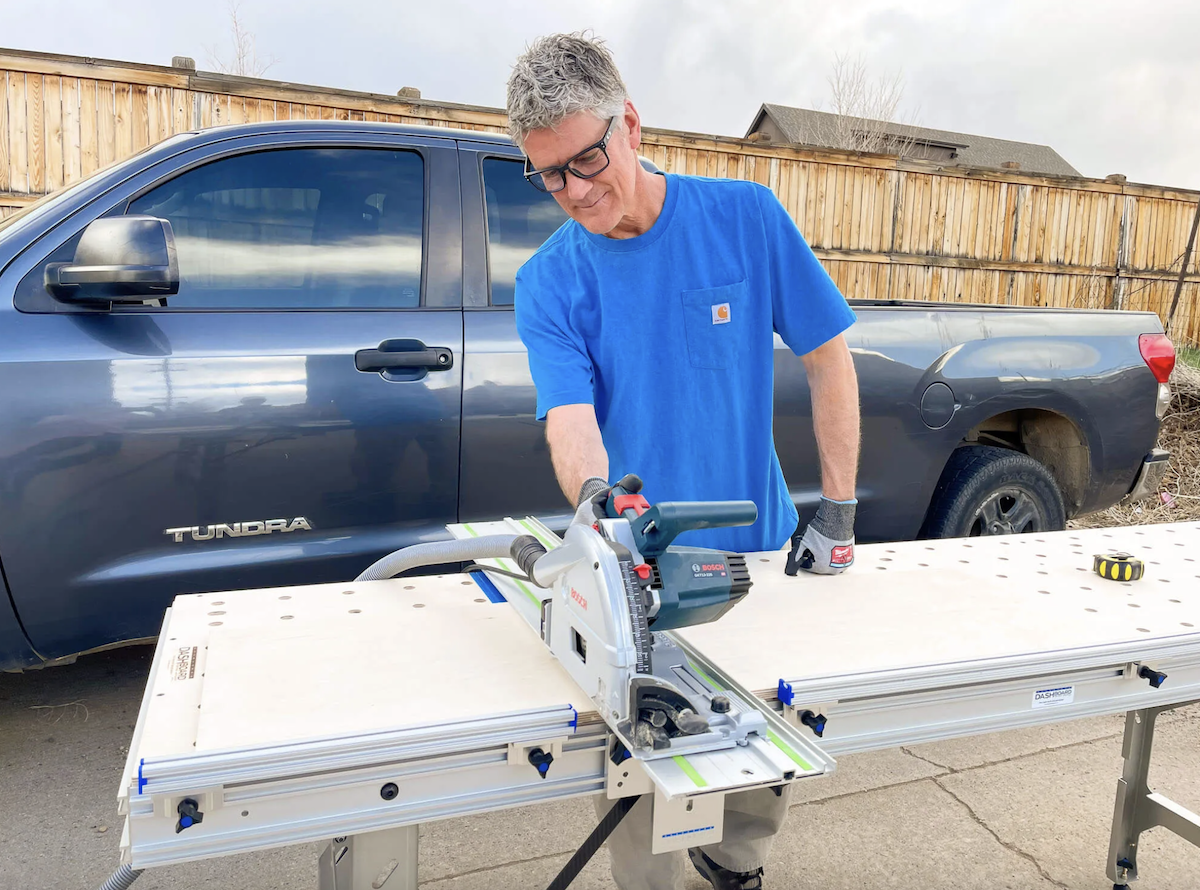
Gabriel Perez discovered this when he replaced his table saw: "The dashboard system has provided better and cleaner cuts, but wow, the dead-on repetition and accuracy of every cut is just so nice. My shop is very small and my table saw had to be in the middle to account for infeed and outfeed distance. The Dash-Board system allows me to completely get rid of my table saw."
Accuracy determines material waste. One ruined $90 sheet of plywood per job = $1,080 annually at 12 jobs. Professional benches eliminate this. Budget benches guarantee it.
Client perception matters. Showing up with sawhorses and warped plywood looks amateur. Unfolding a precision workbench system communicates "I take this seriously."
The Vehicle Storage Problem Nobody Talks About
Contractors working this thread: "The Paulk bench is very nice but not worth moving around unless you're going to be on a job for a decent chunk of time IMO. It's just too big and bulky."
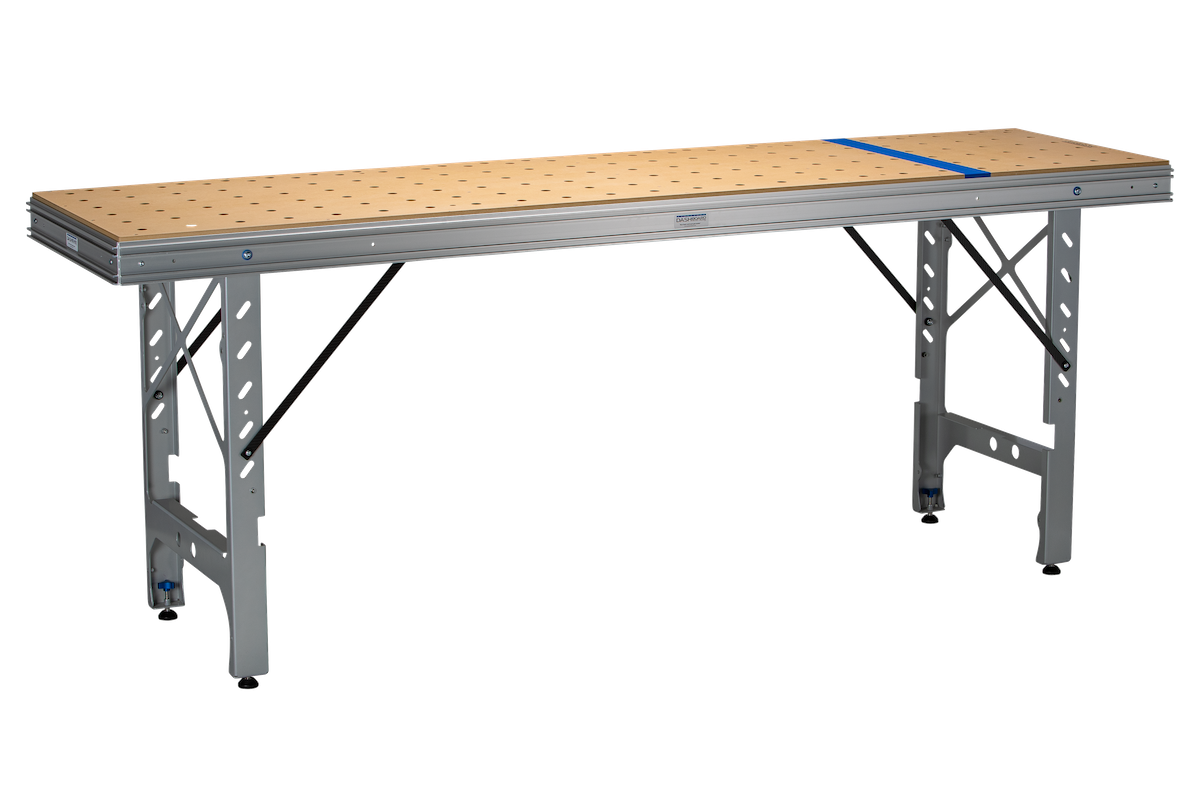
Size when folded determines usability. The Dash-Board folds to 3.5 inches thick—slides under van shelving or mounts vertically against walls. Full-size at 92 inches requires trucks with 8-foot cargo capacity. The ShortCut at 46 inches fits in SUVs and shorter vans.
One contractor: "We keep Keter tables in my work van. Very useful!" But later admits: "After lots of use the plastic seems to be getting brittle."
Professionals need benches they'll actually transport. A 4x8 Paulk-style bench stays in the garage because moving it daily isn't worth the hassle. The Dash-Board's 60-65 pounds moves easily while providing shop-level capability.
The MFT Question: Festool vs. Everything Else
Multiple contractors mention the Festool MFT/3: "I have found the mft3 to be surprisingly NOT useful. This is probably just me but considering what it cost me it hasn't justified itself yet at all."
Another: "One clamp on the side rail and a foot at the opposite bottom side to keep the door off the ground. I use it at least two times a week, but I never use the stupid fence or rail setup."
The MFT/3 costs $735. It works, but contractors either love it completely or find it overpriced for what they actually use. The common complaint: great precision system, but too small (roughly 30x40 inches) for full sheet work.
The Dash-Board approach: full 92x24-inch surface with MFT-compatible 20mm/96mm hole spacing. You get the precision accessory compatibility without the size limitations. At $1,699 it costs more than budget benches but less than Festool + necessary accessories.
Dennis May, who owned both: "Very well built I am very impressed. I had the Festool bracket and this far exceeds the quality."
Cliff Fent echoes: "This Bracket is far superior to the Festool Version supplied with their Brackets."
The Weight Capacity Lie
Every portable bench claims 1,000+ pounds capacity. This number is meaningless.
Static load (weight sitting on the bench) ≠ dynamic load (forces during actual work). When you're pushing a track saw through plywood, applying 40 pounds of downward force and 20 pounds of lateral force, that's when budget benches fail.
The DeWalt folding bench reviewer notes: "It might not be as stable front to back as we'd like." That instability shows up during cutting, not during load testing with sandbags.
Wide leg stance and X-bracing handle real working forces. The Dash-Board's leg geometry resists the multi-directional forces of actual woodworking. Budget benches use simple folding legs that want to collapse under lateral pressure.
Stephen LaRoche describes the difference: "I am amazed at the construction and how light and sturdy it is. I was using some vibrating tools on it and the table did not move. It's solid!"
What Contractors Actually Transport to Job Sites
Based on forum discussions, successful contractors use one of three approaches:
Approach 1: Minimum viable setup
- Sawhorses + plywood (traditional, 150+ pounds)
- DeWalt/Keter folding bench ($70-100, adequate for assembly)
- Works for: Simple installations, no precision cutting required
- Fails for: Cabinet work, trim carpentry, repeated accurate cuts
Approach 2: The Paulk/DIY bench
- Costs $300-500 in materials and time
- Works great but rarely leaves the shop due to size
- Forum consensus: "It's a beast to haul out"
Approach 3: Professional system
- Dash-Board ($1,699) or Festool MFT/3 ($735)
- Actually gets transported because setup is fast
- Handles precision work on-site
- Pays for itself through efficiency and accuracy
The Cabinet Installer's Reality
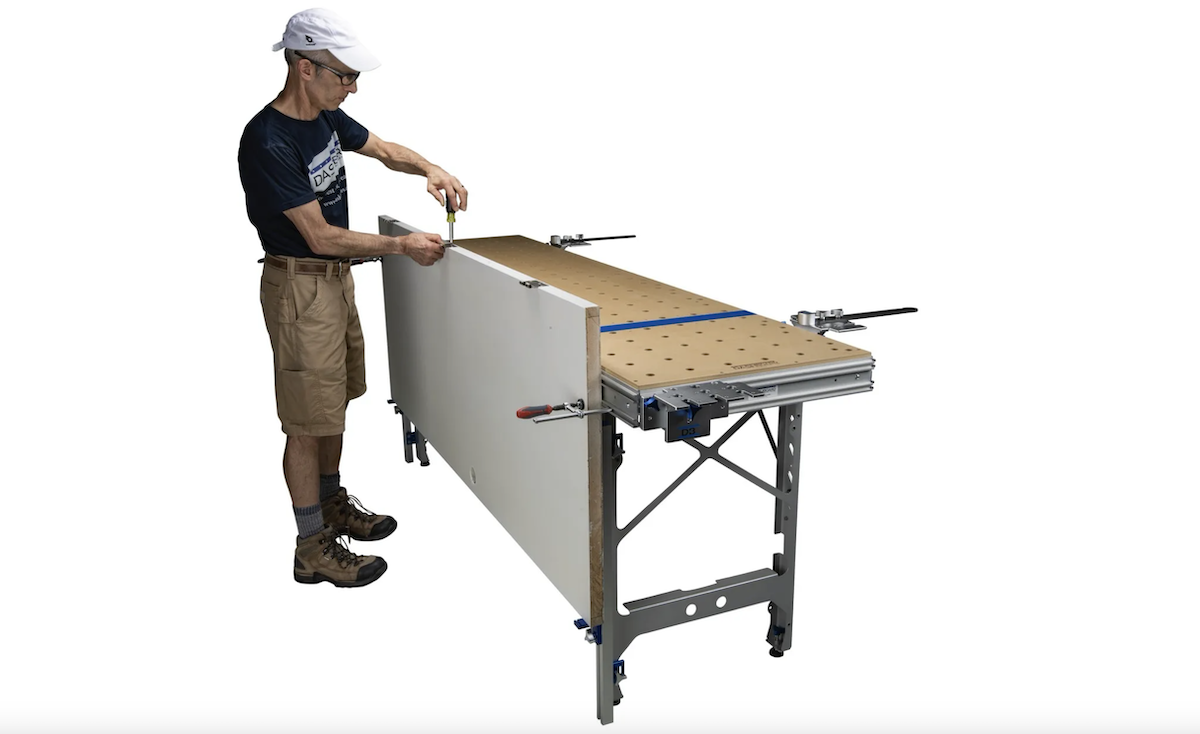
Multiple contractors mention using benches for door work: "I use my mft/3 for mortising doors and boring for lock sets. One clamp on the side rail and a foot at the opposite bottom side to keep the door off the ground."
Door and cabinet installation requires:
- Secure vertical clamping (doors can't rock during hinge routing)
- Height adjustability (working on different door heights)
- Precision jig positioning (repeated hinge mortises must align)
- Convenient setup
Douglas Pelchat, a professional cabinetmaker: "No more constant checking to confirm that the rail is square to my fence. As a professional cabinetmaker, being confident in my set-up speeds production, reduces waste and makes the whole process flow smoothly."
The Van/Truck Organization Challenge
Contractors working from vans face unique constraints. One mentioned storing two Keter benches in an E-Series van. Others describe mounting systems:
- E-track mounting against van walls (workbench hangs vertically)
- Ceiling-mounted pivoting brackets (bench drops down when needed)
- Sliding under custom shelving (requires thin profile when folded)
The Dash-Board's 3.5-inch folded thickness and 24.5-inch width fits standard van shelving depths. Mount it vertically using E-track and it's instantly accessible while preserving floor space for materials.
What Contractors Wish They'd Known Before Buying
From forum discussions, repeated advice:
"Don't buy based on weight capacity claims. Test lateral stability."
"If it's too big to move easily, you won't use it. Size when folded matters more than size when open."
"Plastic tops fail. Period. Wood only."
"Proprietary accessories lock you in. Standard 20mm spacing gives you options."
"Same-day customer support matters when you're on a job. Companies that ghost you after the sale cost you money."
Jeff Rudolph's experience after trying multiple systems: "The system exceeded my expectations. Repeatable cuts are a breeze, rips and cross cuts on full sheets couldn't have been easier. There is one thing you do have to pay attention to and that is making sure the knobs on the star tracks, guides, etc. are all tight. Once that was on my mental check list, I had no issues."
Then the critical point: "I believe one of the most important characteristics of a company is the quality of the support for their products. In this regard Dashboard is stellar. Their replies to my emails asking for help were quick and helpful. I have even gotten responses on the weekend."
The Upgrade Path Most Contractors Follow
Stage 1 (Starting out): Sawhorses + plywood or $70 folding bench Stage 2 (Getting serious): DeWalt/Keter for assembly, keep sawhorses for cutting Stage 3 (Going professional): Invest in Dash-Board or build custom Paulk-style bench Stage 4 (Optimizing): Add accessories as needed (Outriggers, guide rail brackets, fences)
The mistake: staying in Stage 1-2 after you're billing professional rates. Your equipment should match your skill level and income. Working on a wobbly $70 bench when you're charging $100/hour sends the wrong message to clients and wastes your time.
Specific Trades, Specific Needs
Cabinet installers: Need vertical clamping for doors, height adjustability, quick setup → Dash-Board with Track Stars and guide rail brackets
Trim carpenters: Need accurate repeated cuts, portability, quick breakdown → Dash-Board ShortCut ($1,099) for vehicle-friendly size
Furniture builders (on-site custom work): Need large surface, rock-solid stability, precision → Full Dash-Board with Platinum Accessories Bundle ($2,899 with everything)
Remodelers (maintenance and repair): Need assembly surface, adequate stability, low cost → DeWalt/Keter folding bench ($70-100) adequate
General contractors: Need flexibility for various tasks, decent durability → Mid-tier option or multiple cheap benches
The Boulder Advantage Nobody Talks About
The Dash-Board ships from Colorado. Not China. Not overseas. Why this matters:
Lead time: 2-3 weeks, not 12-16 weeks for international shipping. Customer service: Same-day email responses, mentioned in multiple reviews. Quality control: American manufacturing standards. Warranty support: Direct factory support, no intermediaries.
Oleg Strelets: "5 stars is very little. 7-star workmanship. 7-star service. 7-star packaging. I am delighted. Great company. Highly recommend."
Compare this to budget imports with zero customer support after purchase. When you're mid-job and something breaks or you have a setup question, same-day support prevents costly delays.
Making the Decision: Questions to Ask Yourself
- How often do I use it? Daily professional = invest properly. Monthly hobby = cheaper options work.
- What's my billable rate? Over $75/hour = equipment efficiency directly affects income. Under $50/hour = time savings less critical.
- Where do I work? Multiple job sites = portability essential. Single location = stationary bench acceptable.
- What's my primary operation? Precision cutting = need professional grade. Assembly and support = budget options adequate.
- How long do I plan to do this? 5+ years = amortize cost across long timeframe. 1-2 years = rent or buy used.
- What's my vehicle situation? Full-size truck/van = can transport 92" bench. SUV/sedan = need ShortCut size.
- Do I already own track saw system? Yes = maximize that investment with proper support bench. No = integrated system provides value.
The Bottom Line from Contractors Actually Using This Stuff
Peter Michaelson sums up the professional perspective: "While the table is expensive compared to others on the market, the quality of the materials, design, robustness and adaptability are unmatched by other tables and more than offset its cost. For those who are serious about woodworking and want to improve their shop and their woodworking experience, this table is a welcome addition."
Budget benches serve a purpose. For assembly, light duty work, and occasional use, they're adequate. But contractors doing precision work daily need equipment that matches their skill level.
The Dash-Board costs 20x more than a $70 folding bench. It also lasts 10x longer, sets up 10x faster, and delivers accuracy that pays for itself by reducing waste and saving time.
Your choice depends on what you're actually doing and what your time is worth. Choose wisely, because fighting your equipment daily is the most expensive option of all.
Dash-Board Workbench: $1,699 | ShortCut Workbench: $1,099 | Free shipping over $100 | (303) 376-5703