Your Cart
Product Title
$0
$0
-
+
Your cart is empty.
Add Discount Code?
Add Cart Note?


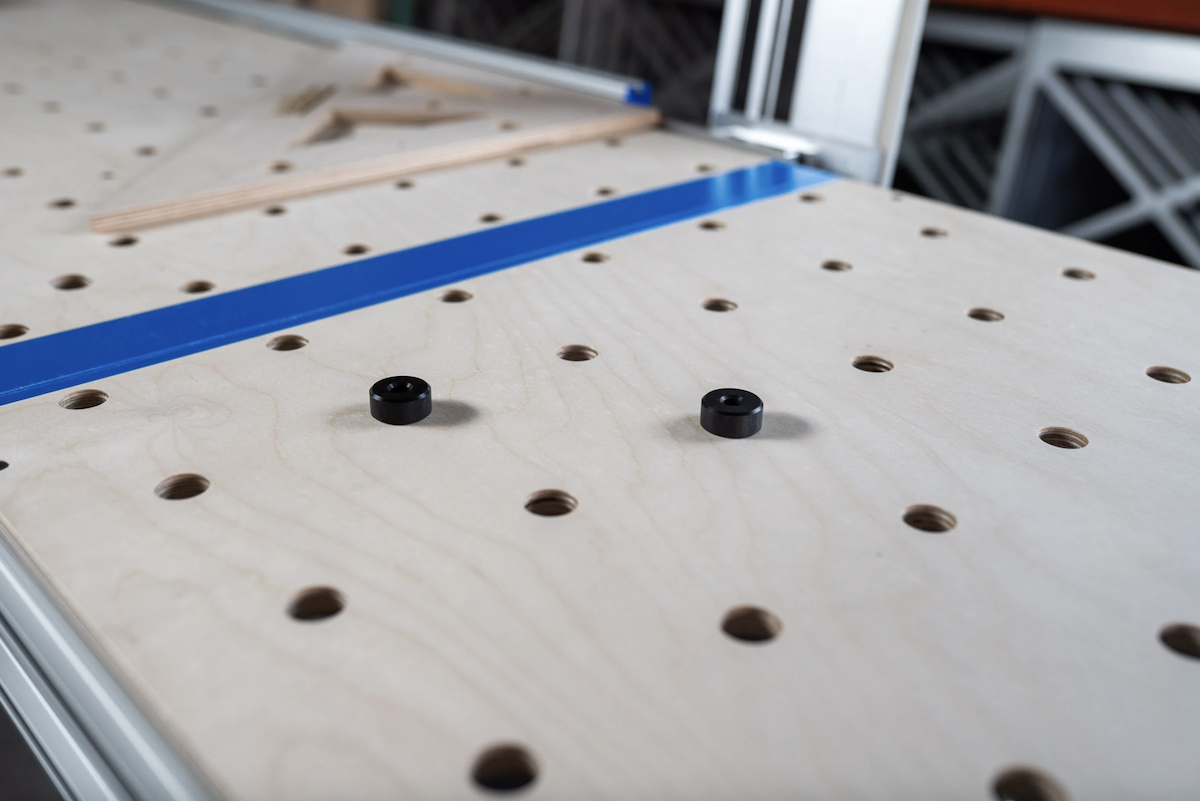
Most woodworkers buy their first set of bench dogs without thinking much about the holes they drop into. Then something doesn't fit, or a setup that was square on Tuesday isn't square on Thursday, and the questions start. This guide covers bench dogs and 20mm dog holes from the ground up: what the 96mm grid actually is, why the spacing was chosen, what mounts in the holes and what doesn't, how to pick dog heights, and how to use the grid as a measuring system instead of just a place to stick pegs.
Rob Schumacher spent ten years working out the answers to these questions the hard way, first as a trim carpenter and cabinet installer fighting a bench that moved under him, then as the designer of the Dash-Board system. What follows is the practical version.
A 20mm dog hole is a 20-millimeter-diameter hole bored vertically through a workbench top to accept bench dogs, stops, clamps, and accessory mounting hardware. The 20mm diameter is the standard across multi-function tables and their aftermarket ecosystem, which means a dog bought from one maker will drop into a compatible bench from another. The hole does two jobs at once: it holds the accessory down, and it locates it at a known position on the surface.
That second job is the one people underuse. A dog hole is not just an anchor point. It is a coordinate.
The 96mm grid is the spacing pattern of 20mm dog holes on a multi-function workbench, with holes positioned 96 millimeters apart from center to center along both axes. Festool established the 96mm spacing on the MFT line, and because accessory makers designed around it, the pattern became the de facto standard for the category. Benches built to that standard share accessories freely.
Ninety-six millimeters works out to roughly 3.78 inches, with about 76mm of clear top surface between the edges of adjacent holes.
The number itself is doing quiet work. 96 is divisible by 2, 3, 4, 6, 8, 12, 16, 24, 32, and 48. In practice that means you can halve a span, split it in thirds, or step it in quarters and still land on whole units of the grid.
It also means squaring math gets easy. A 3-4-5 right triangle, the oldest squaring check in the trades, maps directly onto the grid: three hole steps is 288mm, four is 384mm, five is 480mm. Drop dogs at those counts and you have a verified 90 degrees without touching a tape measure.
This is the single most common point of confusion for new owners, and it is worth getting straight before you buy anything.
A Dash-Board or ShortCut bench has two completely separate mounting systems:
They do different things, they take different hardware, and confusing them leads to ordering the wrong accessory.
Track Starslive in both worlds. They mount to the bench through the side clamp tracks, but they carry their own 20mm holes and slots on their surface. So a Track Star is a T-track accessory that then becomes a 20mm mounting platform out past the edge of the bench. That is how Parallel Guides and fences get positioned outboard for full sheet rips.
One more detail specific to Dash-Board tops: alongside the round 20mm holes, the benchtop includes slotted holes that accept SpiRail Dogs. Those are useful when you are working shorter pieces and want the rail registered closer in.
Dash-Board Bench Dogs ship four to a set in three heights. The height refers to the portion that stands above the table surface, and that portion is 1 inch (25mm) in diameter regardless of which height you choose.
If you are only buying one set, buy Medium. It is the everyday height, it pairs naturally with the Setup Blocks, and it is the height that already ships with the Guide Rail Bracket Set. Most owners eventually keep two or three sets staged so they are not swapping dogs between setups.
Every Dash-Board Bench Dog is machined from Delrin, an engineering plastic, rather than steel or aluminum. The reason is practical rather than exotic. Metal dogs will dent and deform if dropped, but Delrin just bounces and keeps on truckin'. Delrin absorbs the hit without marking the bench and without breaking. Over a few years of daily use, that difference shows up on your benchtop.
Here is the sequence that turns the grid from a clamping surface into a measuring system.
The advantage of steps 2 and 5 is that both use physical references rather than measurements. Physical references do not drift, and they do not care whether you are tired at the end of a long day.
Crosscutting gets most of the attention, but the grid earns its keep on rips.
Dash-Board Parallel Guides anchor into the benchtop's 20mm holes or into Track Stars rather than clamping to your guide rail. That is a meaningful difference. When your parallel guides reference the bench, the bench is the constant. When they reference the rail, you inherit whatever the rail clamps are doing.
Each guide carries two reference heights: a 6mm end that slips under the rail for narrow cuts, and a 29mm aluminum cap end that raises the reference for stacked or slightly warped material. Pair them with the Rip Gauge and you set both sides of the blade from a single kerf-corrected standard instead of calibrating two scales independently.
For rips wider than the bench, the guides move out to Track Stars, and the workflow stays identical.
Three different parts, three different jobs, and the names get mixed up constantly.
If you are buying a Guide Rail Bracket Set, note that it already includes 4 Medium Bench Dogs, 2 Universal Setup Blocks, and 1 SpiRail Dog, so you may already own more of this than you think.
Dash-Board dogs and grid accessories work on any bench with a true 20mm hole pattern, including:
One caution worth stating plainly: 20mm is not the same as 3/4 inch. Three-quarters of an inch is 19.05mm, so a 3/4-inch dog in a 20mm hole leaves nearly a millimeter of slop, and a 20mm dog will not enter a 3/4-inch hole at all. If you are buying dogs for a bench you did not drill yourself, confirm which standard it uses before ordering.
If you are drilling your own top, the grid is the easy part. The side tracks are where people get it wrong.
Dash-Board supplies both T-bars and T-bolts with Guide Rail Brackets and Track Stars. The T-bolts fit any track with at least a 7mm opening and 12mm interior width. The T-bars are 6mm thick and 12mm tall, need the same 7mm minimum opening, and require interior width over 12mm with depth to clear 6mm of material. Mini T-track will take the bolts but not the bars.
For mounting position on a wood-framed table with a 3/4-inch (18mm) top, center the track either 29mm or 39mm below the work surface. Those two dimensions correspond to the two sets of mounting holes on the Guide Rail Bracket and Track Star base plates. Either set it in a dado flush with the bench side, or surface mount it with a second piece below it separated by about 30mm so the base plates have vertical backing and cannot cantilever off a single point. Full details are on the FAQ page.
If you are starting from scratch, the practical path is a set of Medium Bench Dogs, a pair of Universal Setup Blocks, and the Guide Rail Bracket Set, which bundles both. Add Parallel Guides and Track Stars when you start ripping sheet goods. If you are upgrading an existing MFT-style bench rather than replacing it, the Core MFT Bundle covers the same ground.
See the full range on the shop page, watch the setup sequences on the videos page, or call Rob directly at (303) 376-5703 if you want a second opinion on what your bench actually needs.
Worth reading next: What Is an MFT Table, and Do You Actually Need One? and Setup Blocks 101.
Dog holes on an MFT table are 20mm in diameter, which is the standard across the multi-function table category. Festool established the size on the MFT line and accessory makers designed around it, so a 20mm dog from one manufacturer fits a compatible bench from another. Note that 20mm is not equivalent to 3/4 inch, which measures 19.05mm and produces a loose, inaccurate fit.
The spacing between 20mm dog holes on a standard MFT-style grid is 96mm from center to center, measured in both directions across the benchtop. That works out to roughly 3.78 inches, leaving about 76mm of clear surface between adjacent hole edges. The 96mm figure divides evenly by 2, 3, 4, 6, 8, 12, 16, 24, 32, and 48, which makes symmetrical layouts and squaring checks straightforward without arithmetic.
Buy the Medium (½ inch) Bench Dogs first if you are only purchasing one set. Medium is the general-purpose height, it pairs naturally with Universal Setup Blocks for guide rail registration, and it is the height already included with the Guide Rail Bracket Set. Add Tall (1 inch) dogs when you need vertical workholding or rail-back registration, and Short (3/16 inch) dogs for thin material and low-profile setups.
Dash-Board Bench Dogs fit the Festool MFT3, the older MFT 1080, the Benchdogs Ultra MFT, and any shop-built bench drilled to the standard 20mm grid. They drop in without modification or proprietary hardware.
Guide Rail Brackets do not mount in 20mm dog holes. They attach to the dual clamp tracks running along the sides of the bench using T-bars or T-bolts, both of which are included in the set. The 20mm grid on the benchtop and the side clamp tracks are two separate mounting systems. Track Stars and Outriggers also mount in the side tracks, then provide their own 20mm holes for accessories.
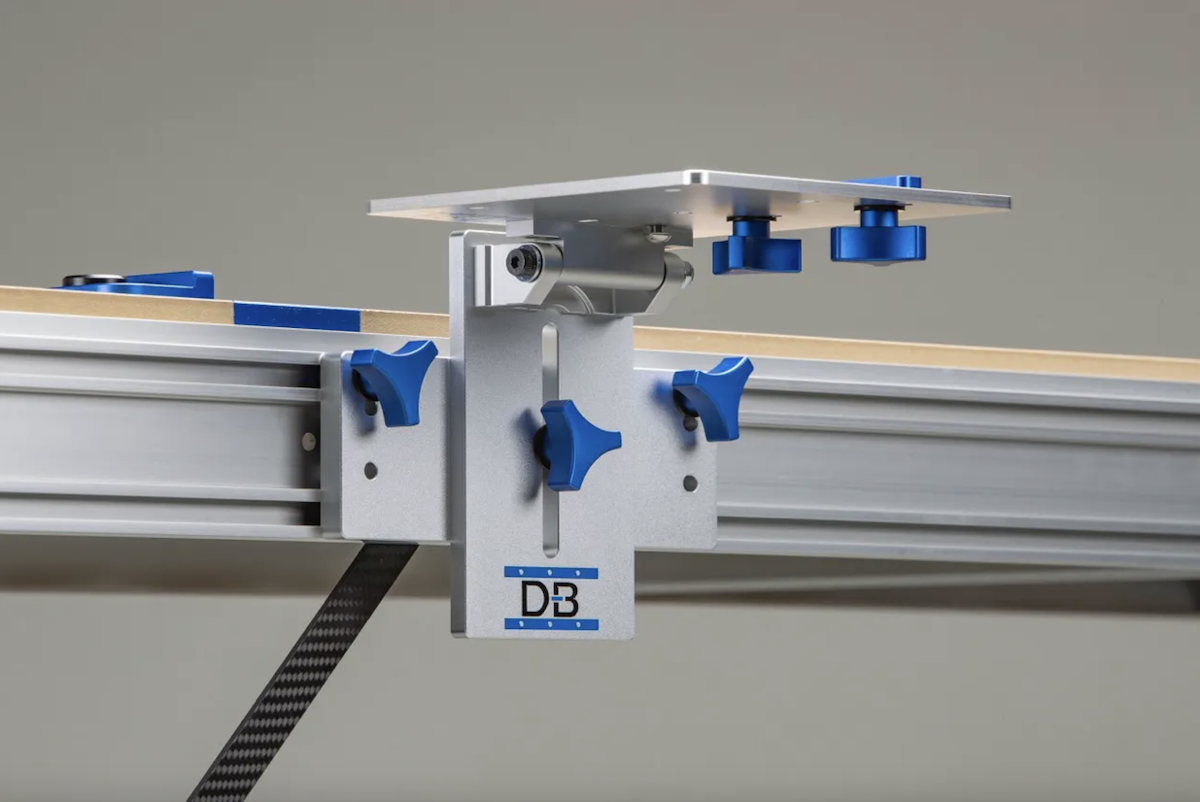
Guide rail brackets hinge your track saw rail to a fixed, repeatable 90-degree position on the bench, so you calibrate square once instead of re-checking it before every cut. Rigid, machined construction with no play is what lets the rail hold that reference through height changes and daily use, turning setup into a one-time task rather than a recurring chore.
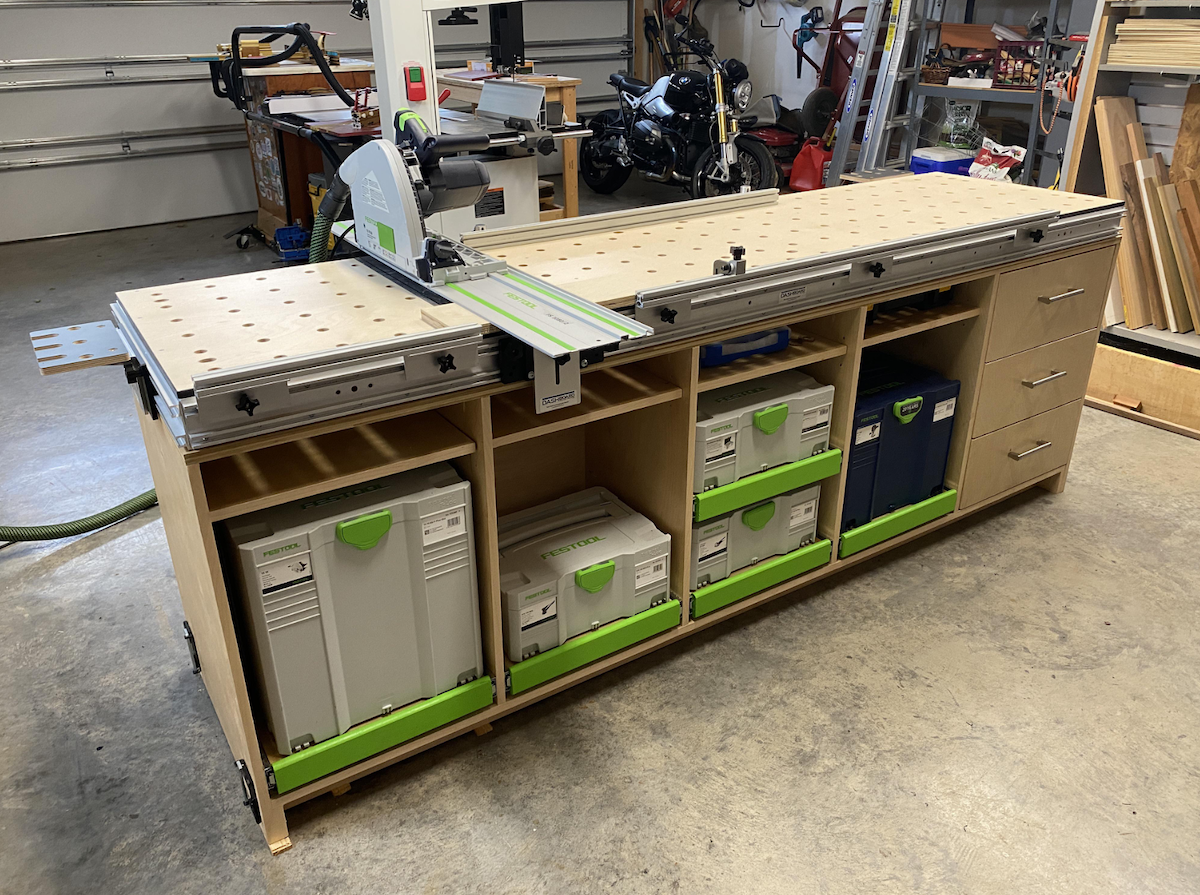
An MFT is a Multi-Function Table built around a perforated 20mm hole grid and guided cutting, letting you crosscut, clamp, sand, rout, and assemble all on one portable surface. It's a strong fit if you do precision crosscuts and sheet goods work, though drift and rigidity issues in some designs are why many owners upgrade to sturdier aftermarket benches and brackets.
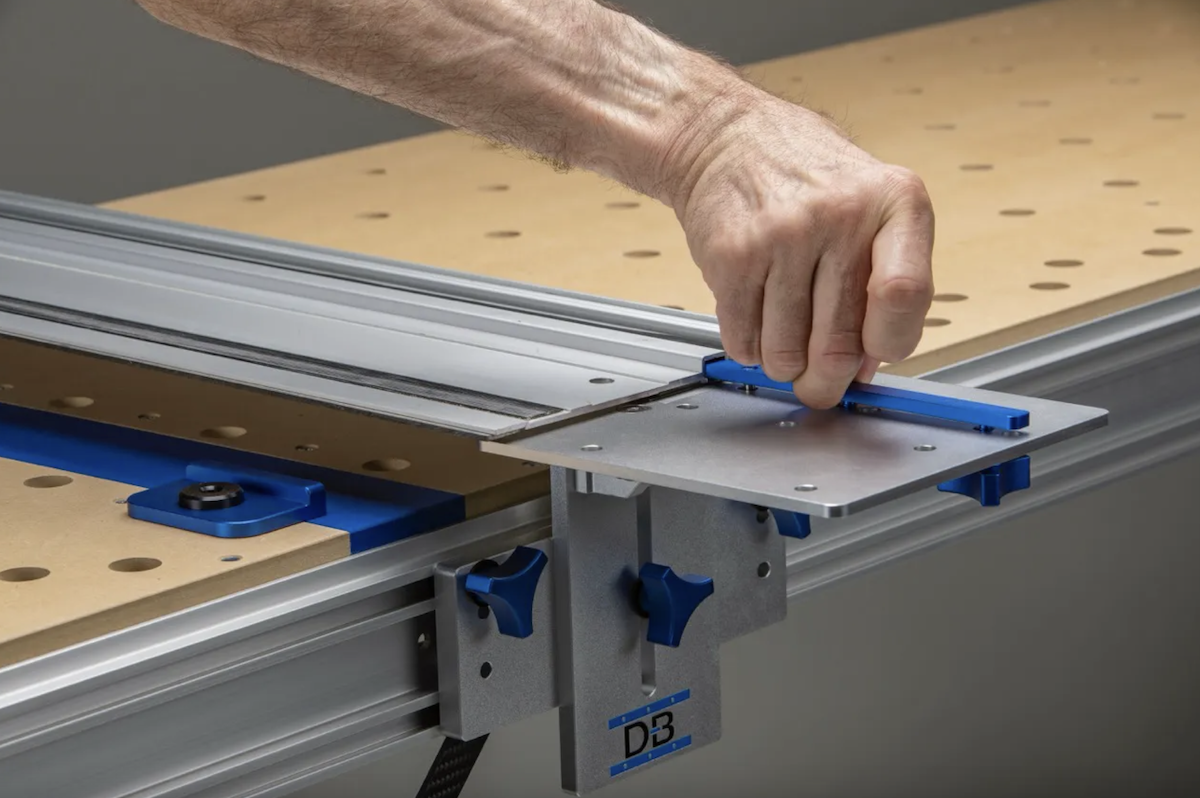
Track saw rail slip almost always comes down to dirty or worn grip strips, dusty or slick surfaces, or not enough downward pressure, and cleaning the strips plus clearing the workpiece solves most cases instantly. For repeatable, no-slip accuracy, clamps work but a fixed bench bracket system locks the rail in place for good.
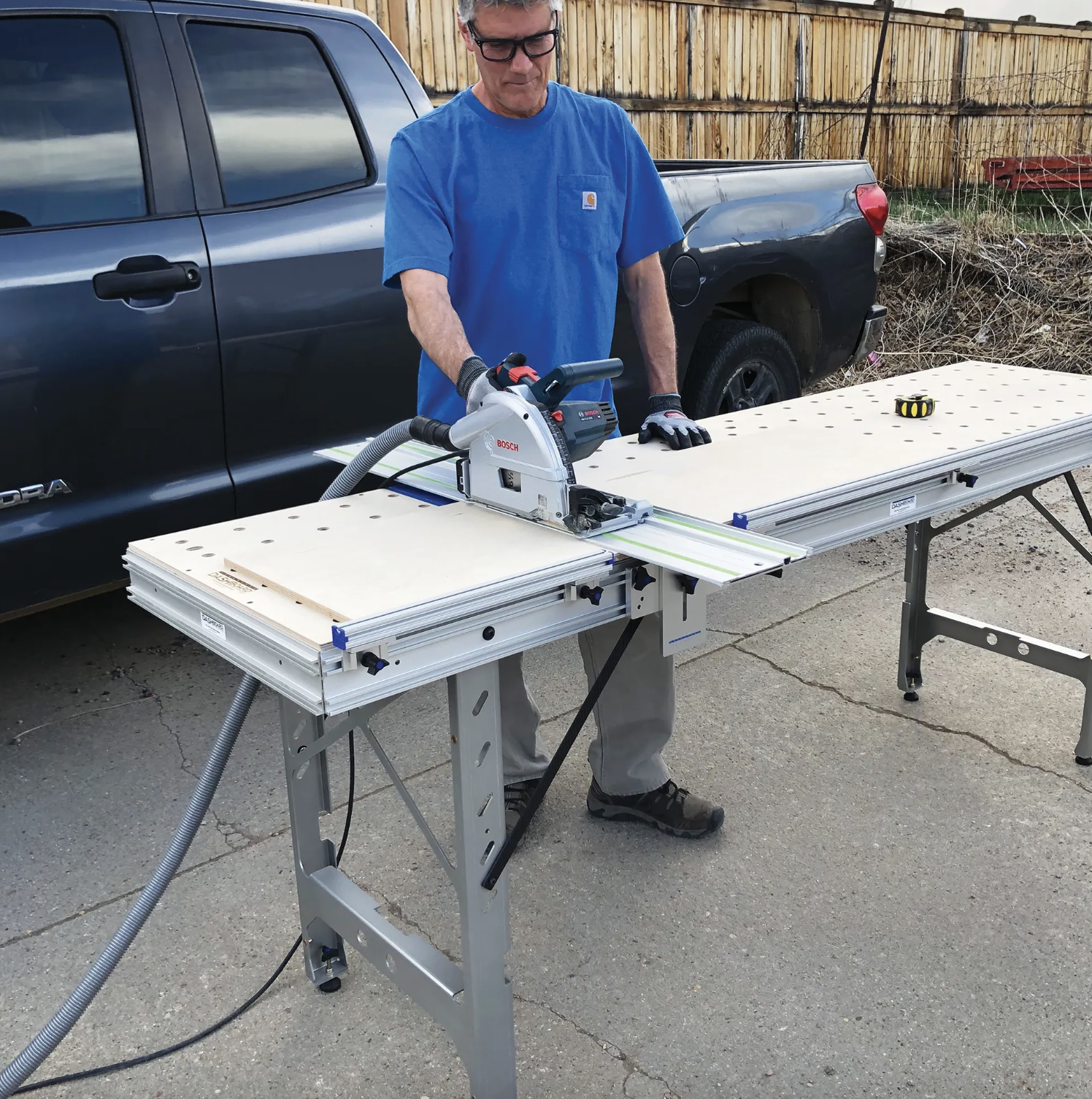
Scribing transfers the wall's true contour onto a cabinet edge so it fits tight against uneven walls and floors, and a portable bench that levels on the spot gives you the stable reference needed to mark and cut that line accurately. Level the piece, scribe to the widest gap, trim with the work fully supported, then test and refine until the fit sits flush.
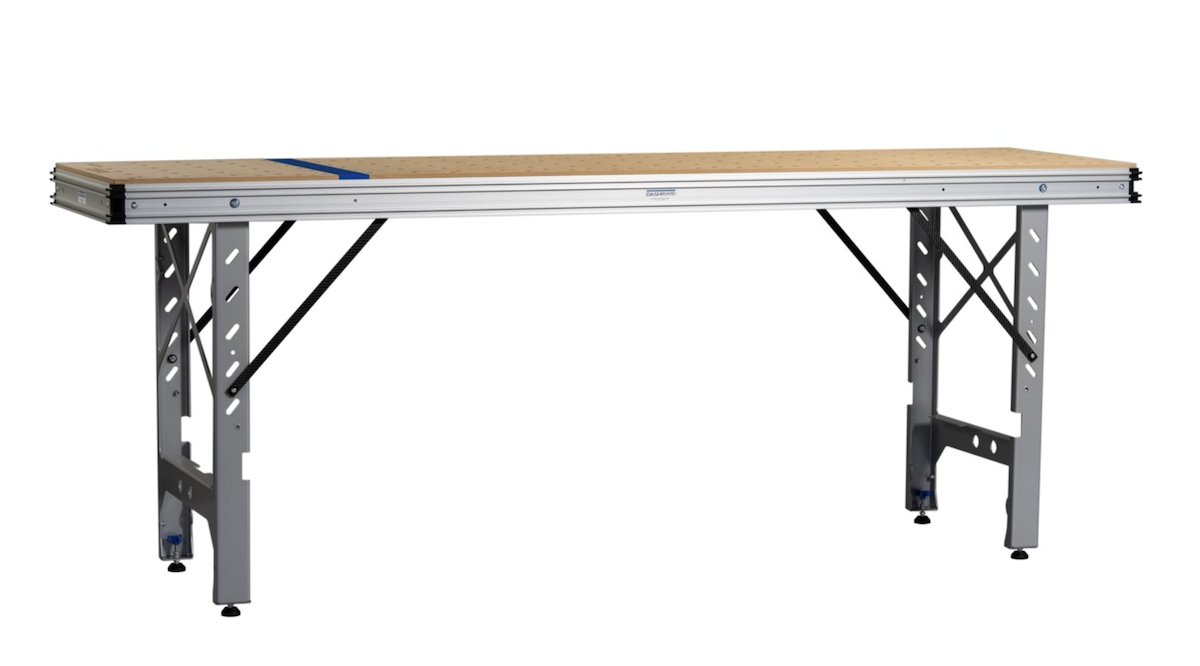
Solid workholding is the whole game with edge banding, and a rigid portable bench with the right clamping accessories lets you present a panel flat or vertical for clean, even application. Lock the panel down, apply the banding steadily, then trim flush once the bond sets for crisp, consistent edges every time.

Straight edge cutting tools like track saws, guide rails, and guide rail brackets give woodworkers a fixed reference so cuts stay true instead of drifting off line. A rigid bench, squared rail, and the right accessories (fences, flip stops, parallel guides) turn one accurate cut into consistent, repeatable results every time.
